The Mangnum opus of Shah Wali Allah, explains his extraordinary spiritual experiences that he underwent during one of his meditations. Hence he decided to compile a work which would cover a vast spectrum of themes ranging from the philosophy of religion, law, jurisprudence, ethics, psychology, mysticism, sociology, social anthropology and economics to the philosophy state and government. He undertook detailed discussions on various dimensions regarding the Islamic dispensation for human life covering all aspects. This specific discussion on Irtifaqaat is a section from the Magnum opus, the diagram below shall provide a condensed summary of the entire topic.
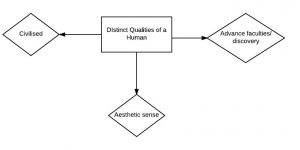
Irtifaqaat¹ is a method deduced for one to adopt convenient ways in order to develop oneself in all areas, so that they may live a healthier and productive life. Shah Wali Allah (rah) has explained irtifaqaat in four stages; if one adheres to these stages they shall have a much more efficient life.
Below is a condensed breakdown of the four stages:
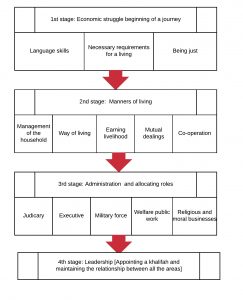
The first stage: The Economic struggle at the beginning of a journey
The primary attainment in this stage of social development [Irtifaqaat] is language which is a tool used to express emotions and a source of communication with other individuals. The essence of this area is that one first masters in speaking the language taking into consideration the different tenses and rules therefore, it is spoken.
The second factor in this category is cultivation of land, plantation of trees, digging of wells, manners of cooking and enriching food, making of pottery and water containers. Likewise all necessities required for survival such as shelter, hunting for food, clothing and so forth. Another attainment in this factor is to identify a potential spouse, one with whom they may fulfil their desires and grow a family.
The third factor in this category is selecting individuals for primary requirements in a society. Here is a list of individuals or groups that are required to start a community.
- Judge: An individual who is just and has sound knowledge of dealing with situations.
- Counsellors: A group of individuals who will discover methods of social development and everyone else will follow.
- Educators: A group of individuals that have sharp intelligence
- Materialist’s: A group of individuals who have an interest in beauty, luxury and comfort.
- Traditionalist: A group of individuals who wish to spread their moral traits.
[Note: the terms that have been used above are a summary done by myself this is not how it has been mentioned by Shah Wali Allah (rah)]
The second stage: Manners of living
This secondary stage establishes all the requirements of sociability, managements of the household, mutual dealings, etiquettes in a daily basis and dealings amongst people. By the management of household we mean by the wisdom to discover ways and means of preserving the relationships between the members in the household.
Another factor that has been mentioned in this category is mutual dealings or transactions. The fundamental principle in this respect is that when human needs multiplied and man sought to attain excellence in their satisfaction provide comfort to the eye and pleasure to the soul, it became difficult to achieve this purpose by individual effort².
The third stage: Administration and allocating roles
Siyasah al-Madinah is administration in the city state this is the wisdom concerned with assembling all the members of the city state and preserving relations between them. There are many roles required to be mastered for there to be a firm state or city. Some are as follows:
These are three groups in forming law:
- Judiciary: ratify
- Executive
- Legislative: committee
However, it is also necessary to understand that in order to qualify as a ruler there are certain qualities which need to be present:
- Aadil- just
- Is this role within their lineage or not
- Did they appoint themselves or not?
- Do they have the ability to carry out this job?
*A-D has been mentioned in Fathul Mulhim of Allama Shabbir Ahmed Uthmani under the chapter of Kitaab ul Imaraah, pp.224-227
Additional factors that have been mentioned by Shah Wali Allah are as follows:
- Free, male, adult and sane
- Competent
- Knowledgeable
- Balanced in emotions
The following are few more compartments required to complete a state:
- Military force: the commander of the soldiers should essentiality possess all knowledge in regards to this field. He should also know the ability of each individual under him.
- Well-fare public work: the administrator of internal affair should be an experienced person who has full knowledge about all the policies that could lead to the progress of the state. He should be aware of all the affairs and how it being dealt with.
- Tax-collector: he should know the ways and means of collecting revenues and their distribution among those who are entitled to receive the benefits.
- Secretary for the ruler: this individual will deal with all the other matters which the ruler does not have time to attend to.
The fourth stage: Appointing a khalifah and maintaining the relationship between all the areas
The role of a khalifah [leader overall, the protector of the system]:
- His duty is to set conduct within the land and it should be followed
- He is compelled to make preparations for war to protect his people
- He should be responsible and aware of the consequences of his actions
- It not appropriate for a ruler to take any strong actions which is not warranted by the purpose that he seeks to achieve.
It should be borne in mind that there is no civic system throughout the inhabited world, nor has there been any community of people, possessing balanced temperaments and virtuous morals since the time of Adam (as) nor will there be one till the day of judgement which is devoid of irtifaqaat. However, this should not be used as an excuse to not even try to create a community or system which follows the rules of irtifaqaat³. During the time of fitn4 instead of changing things around it is best to start from home.
¹ Social development
²Muhammad Al-Ghazaali ‘Selection from Hujjat Allah Al-Balighah’ [2006], New Dehli, p. 28
³Muhammad Al-Ghazaali ‘Selection from Hujjat Allah Al-Balighah’ [2006], New Dehli, p. 45
4. Trials and tribulation
Halima Bint Muhammad Abdul Hannan
22nd Muharram 1439